
Industrial high-speed doors
Kavidoors industrial high-speed roll-up doors are engineered as ideal dividers between high-traffic zones, while providing excellent thermal insulation. Built with high-quality materials, they are specifically designed for intensive industrial and commercial use.
They operate via a fixed IP/IR electrical control panel, equipped with safety elements such as an emergency stop button and photoelectric sensors.


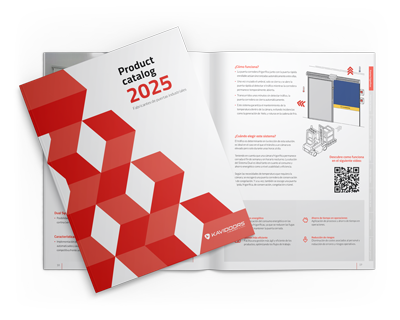
Download our catalog
Download our technical catalogue now and discover how we can optimize your operations with high-quality, efficient products.
Advantages of Kavidoors industrial high speed roll up doors
High-speed roll-up doors are perfect for high-traffic environments like hallways, warehouses, industrial facilities, and labs. Their compact and efficient design delivers superior thermal insulation. Available for both indoor and outdoor use, with wind resistance up to Class 4, depending on the model.
One of the main benefits of these doors is their contribution to energy savings. Their fast opening and closing reduces the time they remain open, limiting temperature exchange between zones and minimizing energy loss, which is crucial in temperature-controlled areas like cold rooms.


Safety features:
- Photoelectric safety sensors to detect people or objects
- Emergency stop button
- Manual opening option in the event of a malfunction
- Transparent vision panels for enhanced visibility
Thanks to their self-repairing curtain system, any impact that causes the curtain to exit the guide is automatically corrected, minimizing downtime and keeping workflows uninterrupted. This ensures maximum uptime and reliable performance without the need for immediate repairs.
Any questions? Get in touch with us
Why choose Kavidoors high-speed roll up doors?
- Energy-efficient: Fast opening/closing minimizes temperature loss, reducing energy consumption.
- Improved workplace safety: Integrated photoelectric barriers stop the door when people or objects are detected. Optional vision panels allow faster and safer passage.
- Workflow continuity: The self-repairing function resets the curtain after impact, avoiding repair delays.
- Faster operations: Speeds up material flow, transportation, and logistics processes.


- Low noise emissions: Silent operation ensures minimal acoustic disturbance, especially beneficial in outdoor areas subject to wind.
- High insulation performance: Efficient sealing and quick cycles offer excellent thermal insulation, blocking dust and external contaminants.
- Ease of use & maintenance: Easy to install, low-maintenance, and user-friendly for all operators.
- Custom color options: Available in a wide range of colors to match your brand or facility requirements.
Any questions? Get in touch with us
FAQs about high-speed doors
-
What type of industrial high-speed door do I need?
The choice depends on whether the door is for indoor or outdoor use, opening dimensions, temperature, traffic type, number of daily cycles and environmental conditions. Kavidoors offers standard, self-repairing, cold-storage, double-curtain, cleanroom, horizontal-opening and stacking high-speed doors. Each solution addresses different requirements for speed, sealing, insulation, wind resistance and hygiene.
-
Should a high-speed door be installed indoors or outdoors?
Indoor high-speed doors are mainly used to separate work areas, control traffic and reduce air exchange between spaces. For outdoor applications, the door must be suitable for wind, rain, temperature changes and direct exposure to weather. Kavidoors offers solutions such as stacking and spiral-panel models suitable for certain outdoor applications, depending on the location and access conditions.
-
What wind resistance does an outdoor high-speed door need?
The required resistance class depends on the building’s exposure, façade orientation, geographical location, opening dimensions and how often the door remains open. Not all high-speed doors provide the same resistance. Kavidoors offers configurations with different wind resistance classes, from solutions for protected indoor areas to stacking doors with resistance up to class 5. Selection should be based on the actual conditions of the access.
-
What maximum dimensions can a high-speed door have?
Industrial high-speed doors are manufactured according to the opening dimensions, within the technical limits of each model. In addition to width and height, the available side space, lintel clearance, support type and possible obstacles such as pipes or structures must be checked. For particularly large openings, a stacking, horizontal-opening or rigid spiral door may be required.
-
What opening speed do I need for my traffic volume?
The required speed should be selected according to daily traffic, vehicle type, approach distance and the need to control temperature or minimise waiting times. In high-traffic areas, faster opening improves circulation and reduces the time the access remains open. However, speed must be balanced with safety, dimensions, wind resistance and activation system. Kavidoors offers solutions from 1 m/s to 3 m/s in some models.
-
Which high-speed door is suitable for cold storage or cleanrooms?
Cold-storage rooms require a door designed to limit cold loss, condensation and ice formation. Kavidoors offers solutions for storage at 0 °C, freezing at −20 °C and double-curtain cold-storage doors for conditions down to −30 °C. In food processing, easy cleaning, sealing and moisture resistance are key. In cleanrooms, the door should reduce air permeability and help control pressure, temperature and exchange between areas.
-
What safety systems should a high-speed door have?
A high-speed door should incorporate devices capable of detecting people, vehicles or obstacles and stopping or reversing movement when there is a risk of contact. Kavidoors high-speed doors include photocells, an emergency stop and manual opening in the event of failure. They also use two independent photocells: one located in the guides to detect obstacles and another in the lintel to monitor correct curtain winding.
-
Which activation system should I use?
The activation system should be selected according to the type of traffic and the level of control required. Common options include radar sensors, magnetic loops, remote controls, push buttons, pull cords, photocells and access control systems. For forklift or continuous traffic, automatic detection allows the door to open before the vehicle arrives and avoids unnecessary stops. Radar sensors can also distinguish object direction and movement to reduce unwanted openings.
-
What maintenance does it need and what if it is hit?
Maintenance should include inspection of the curtain, guides, safety systems, motor, control panel and activation devices. Frequency depends on daily cycles, environment and intensity of use. In areas where impacts are likely, a self-repairing door is advisable. After an impact, the curtain can leave the guides without being damaged and automatically return to its position during the next cycle, reducing repairs and downtime.
-
How much does an industrial high-speed door cost?
The price depends on the dimensions, door type, speed, wind resistance, operating temperature, safety systems, activation, finish and installation conditions. To prepare a quotation, provide the opening width and height, available side and lintel space, indoor or outdoor use, traffic type, approximate daily cycles, temperature, wind exposure, preferred opening system and photographs of the area. With this information, Kavidoors can recommend a configuration suited to the actual installation.
