
Cold storage doors
Kavidoors’ industrial cold room doors combine advanced technology and robust design for intensive refrigeration applications (from 0 to -40 °C). Manufactured with high-strength materials, they provide outstanding thermal insulation and airtightness. Ideal for industrial (logistics) and commercial use (hospitality, supermarkets), all doors are CE certified.


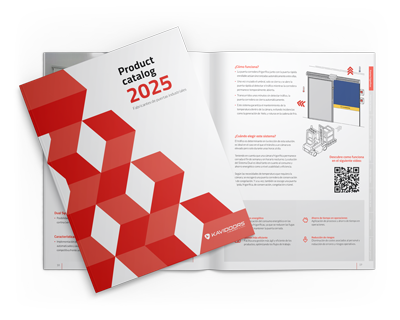
Download our catalog
Download our technical catalogue now and discover how we can optimize your operations with high-quality, efficient products.
Cold room doors for insulation and extreme environments
At Kavidoors, as manufacturers of industrial cold room doors, we offer customized solutions to ensure efficient thermal insulation and high resistance under extreme temperature and humidity conditions. Our cold room doors are manufactured using high-quality materials, guaranteeing compliance with the strictest standards of durability and hygiene. Equipped with airtight seals and reinforced locking mechanisms, they maximize energy efficiency and improve cold chain performance.
It is crucial to understand the differences between refrigeration room doors and freezer room doors. Insulated doors for cold rooms maintain positive temperatures, while freezer rooms operate down to -20°C. For this reason, freezer doors require greater thickness (80, 100, or 120 mm) to ensure adequate insulation, while refrigeration doors typically range between 60 and 80 mm in thickness.


Can the same door be used for both refrigeration and freezing rooms?
The answer is NO. While most models offered by Kavidoors can be installed in both environments, they are not identical; the door panel thickness must be adjusted accordingly. Doors for positive-temperature rooms usually range between 60 and 80 mm. For installations in freezer rooms that must maintain temperatures as low as -20°C, thickness increases to 80, 100, or 120 mm, with the latter two being more common.
Any questions? Get in touch with us
Our range includes models such as sliding doors, hinged doors, roll-up high-speed doors, and air curtains, all specifically designed to meet the demanding requirements of temperature control and energy efficiency. Automatic sliding doors are ideal for quick access, minimizing temperature loss and optimizing product flow in the cold chain.
Choosing the right door is essential for the optimal preservation of sensitive products and for maintaining the cold chain; especially in sectors such as food and pharmaceuticals. Our team of experts is available to help you choose the most suitable solution for your cold storage room, tailored to your specific requirements for temperature, volume, and traffic flow.


Manufacturing industrial cold storage doors
The production of industrial cold storage doors requires a specialized design that guarantees efficient thermal insulation and high resistance to extreme temperature and humidity conditions. These systems are typically constructed from high-quality materials that meet stringent hygiene and durability standards. In addition, airtight seals and reinforced closing mechanisms are incorporated to minimize air infiltration and boost energy efficiency. Depending on the application, the doors can be sliding, hinged, or high-speed, adapting to the unique needs of each installation.
Any questions? Get in touch with us
Frequently asked questions about cold room doors
-
Can the same cold room door be used for storage and freezing?
Certain models can be adapted to both applications, but the configuration must be adjusted to the operating temperature. For cold storage, thicknesses of 60 to 80 mm are common, while freezing applications may require thicknesses of 80, 100 or 120 mm. The choice depends on the specific conditions of each cold room.
-
What thickness should a cold room door have?
It mainly depends on the operating temperature. For cold storage rooms, thicknesses of 60 to 80 mm are common, while freezing rooms may require thicknesses of 80, 100 or 120 mm. The thickness should be selected according to the thermal conditions of the installation and the required insulation performance.
-
What type of cold room door do I need?
It depends on the operating temperature, access dimensions, opening frequency and expected traffic. The insulation, airtightness and hygiene requirements of the installation must also be considered. These factors determine the most suitable cold room door solution and help ensure performance that matches the specific conditions of the refrigeration system.
-
What temperatures can cold room doors operate at?
Kavidoors offers solutions for low-temperature applications, with models capable of operating at temperatures down to -40 °C. The permitted operating temperature depends on the selected solution and its configuration. The door model should therefore be specified according to the actual thermal conditions and requirements of the refrigeration installation.
-
Does cold room door insulation vary with temperature?
Yes. Insulation requirements increase as the operating temperature decreases. For this reason, doors designed for freezing rooms generally require thicker leaves than those used in cold storage rooms. The configuration must be adapted to the thermal conditions of each installation to provide the insulation performance required for the application.
-
Where are cold room doors used?
Cold room doors are used in storage and freezing installations across different sectors. Applications include the food industry, refrigerated logistics, supermarkets, hospitality and industrial refrigeration facilities. The solution should be selected according to the operating temperature, intended use and specific conditions of each access point.
